Press & Podcasts
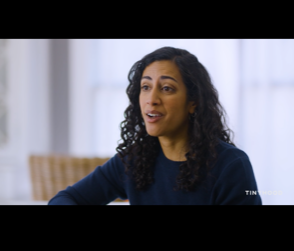
TinyHood Talks about reconnecting with partners post-baby, navigating the mental load of parenting, exploring identity and self-care, and unpacking the myth of "having it all."
"If you go to a store, you might see the 'self-care' aisle, and you might see nail polish or a face mask. I hate to tell you this, but self-care is not a manicure and a bubble bath. The transition to parenthood is real; the stress of being a parent is real. Systems and structures are not supporting us. We cannot have it all. We do not have real paid parental leave or paid childcare. A face-mask is not going to solve that problem, and I personally find it insulting that somebody would think that it would." |
|
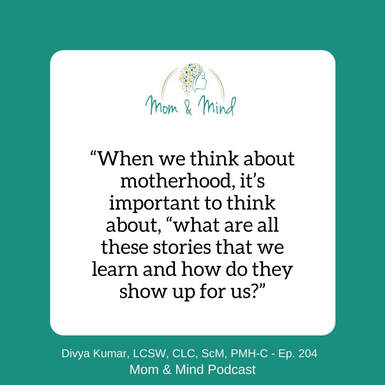
Mom & Mind podcast episode about how cultural and immigration narratives affect perinatal mental health.
"The cultural narratives we were raised with, we carry with us, and they're going to influence how we see ourselves, how we understand motherhood, how we understand ourselves as mothers, whether we think we are good mothers." Doula Stories podcast episode about tuning in to our emotional needs and trauma reactions as BIPOC providers so that we can continue to care for our clients.
"We have to ask ourselves, hat do we need if we are going to hold space for other people? And at that time in 2016, I felt very vulnerable and these new parents needed me to hold space for them. They needed to talk about their own fears, and I needed to reflect on my own stuff as a Brown woman and how it was resurfacing for me and how I could really be there to support other parents." |
|
An interview with Boston Moms on 4/5/2021 about working with perinatal clients and new parents about trauma the transition to parenthood.
"So many folks have experienced so many hard things — in their families, in their homes, in relationships, with parenting, in surviving interpersonal and systemic racism and oppression, financial struggles, you name it. And many folks have never had the space to unload all of it and have someone bear witness to what they have experienced and provide a space for them to reflect on it, make sense of it, feel all the feelings they have had to block out in order to keep going and move toward healing."
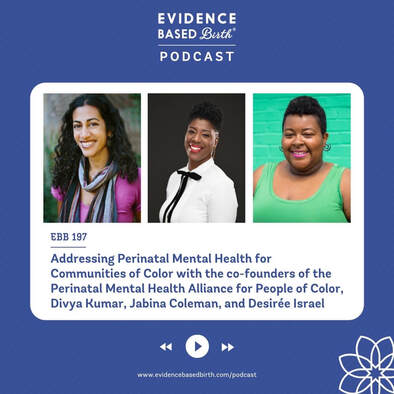
Evidence Based Birth podcast episode with Desirée Israel and Jabina Colman about the Perinatal Mental Health Alliance for People of Color.
"We're trying to create a more robust network, so that clients who are looking for somebody who represents more of their lived experience and understands how they walk through the world is going to be able to see one of us." An interview with Corinne Crossley of Mindful Eating Moms about the intersections of race, racism, trauma, and perinatal mental health.
“I’m always aware of what the dominant paradigm is and the ways in which I’m different. That comes back to the triggering piece and the rawness and vulnerability – all those things are just broken wide open and take your knees out at every turn when you’re a new parent.” |
|